Some inquiries begin with a carefully planned provocation. This one began with a small container, a few tiny caterpillars, and the particular kind of wonder that arrives when something living comes into a room full of children.
They Were So Small
When the caterpillars first arrived, the children noticed immediately how small they were. Smaller than a finger. Smaller than a crayon. Small enough to make you lean in and look carefully.
And so they did. They watched the caterpillars eating, moving, growing. They learned early that observation is its own form of relationship, that paying attention to something is a way of caring for it. This is a land-based understanding as old as the land itself: that knowledge comes through watching, through patience, through showing up day after day and noticing what changes.
This is Respect. Not just respect for the caterpillars, but respect for the pace of living things, which is never hurried and cannot be rushed.
A Week Away
Then the daycare closed for a week, and the caterpillars kept working without us.
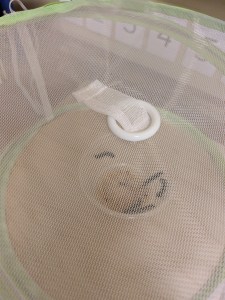
When everyone returned, something was different. I noticed it first, quietly, before the children arrived. The caterpillars were gone. In their place, chrysalises hung still and patient, doing the extraordinary, invisible work of becoming.
I had a little secret to share.
Shoes were barely off before the children made their way to the table to see for themselves. What they found there asked something of them that doesn’t come easily at this age: stillness. No petting, no holding. Just looking, and that particular kind of childhood wondering that doesn’t need an answer right away.
One child leaned close and said, simply and with complete hope, “Come out butterflies.”
This is Wisdom, trusting what you cannot yet see. It is also a land-based way of knowing, understanding that transformation happens on its own terms, in its own time, and that our role is to witness it with humility, not to hurry it along.
The Waiting
The chrysalises did not open quickly. And so we waited, which turned out to be its own kind of learning.
While we waited, we read Moth and Butterfly TA-DA! by Dev Petty, a story about two friends who emerge from their transformations changed, and discover what is different and what remains. It opened conversations about wings, about moths and butterflies, about what makes each one itself.
We also painted. Lots of colour, big paper, folded in half. The invitation was to explore symmetry, the same quality that makes a butterfly wing what it is: one side mirroring the other, balanced, whole. The children discovered through their own hands what they had been observing with their eyes. Butterfly wings are symmetrical because symmetry is how nature builds strength and beauty at the same time. Their paintings showed the same thing.
Engagement, in the language of Ontario’s How Does Learning Happen?, is not always loud. Sometimes it looks like a child pressing paint carefully onto paper while keeping one eye on a chrysalis across the room.
Eclosion
And then, one day, the butterflies came.
The word for it is eclosion, the emergence of a butterfly from its chrysalis, and it is one of those words that earns its place. What the children witnessed was not a small thing. A creature that had dissolved itself almost entirely inside a small papery shell and rebuilt itself into something winged and brilliant was now here, in the room, opening and closing its wings like it was learning how to exist.
Truth. The children had been told this would happen. They had read about it, talked about it, and painted around the edges of it. But watching it happen was different. The body knows things that words can only point toward.
On Their Last Day
The butterflies spent their last day with us in their enclosure, and the children spent it watching.
The butterflies ate, tasting juice from slices of orange, and the children were close enough to see their proboscises, those delicate, unfurling tongues, reaching into the fruit. It was a moment of genuine scientific wonder, the kind that doesn’t need a worksheet to make it meaningful.
One child watched a butterfly cross the enclosure and said, “He looks like a bird.”
That is a child doing real thinking. Drawing on everything they know about winged creatures, about movement, about the way things look when they are fully, freely themselves. It is the kind of observation that reminds us that children are not empty vessels waiting to be filled. They are already making sense of the world, all the time, in ways worth paying attention to.
When we asked what they thought would happen when the butterflies left, the children answered with the full generosity of early childhood:
“They will find bigger butterflies.”
“They will make new friends.”
“I want them to come to my house.”
There is Love in those words. And there is Belonging, the understanding that these butterflies had been part of something here and that sending them out into the world was an act of care, not loss.
Flying Away Home
We waited for the sun.
When it came out, we took the enclosure outside and opened it. The butterflies didn’t hesitate. They lifted, caught the light, and went.
As they flew, one child watched them go and said, “They’re flying away home.”
There is a land-based truth in that sentence that the child arrived at entirely on their own. That the outside is not somewhere foreign or separate from us. It is home. For the butterflies, yes. And in some way that children understand more readily than adults, for all of us.
This is Humility. We are not the center of the story. We were the ones who made space, who watched carefully, who learned to wait. The butterflies did the rest.
What the Children Showed Us
Across this inquiry, the children demonstrated learning that touched every foundation of How Does Learning Happen?
Belonging. The caterpillars, the chrysalises, and the butterflies were never just a project. They were members of the community, spoken about with ownership and tenderness, missed during the week away, celebrated when they emerged.
Well-Being. There is something deeply regulating about caring for something small and living. The children brought their full, quiet selves to the enclosure in a way that was different from other moments in the day.
Engagement. This inquiry sustained itself from arrival to release without flagging once. The children returned to it again and again, with new questions, new observations, new things to say. That is what genuine engagement looks like.
Expression. Through symmetry painting, through language, through the careful attention of their eyes and bodies, through “come out butterflies” and “he looks like a bird” and “they’re flying away home,” the children expressed what they knew and felt in every way available to them.
A Note for Families
Your children witnessed something real and rare this season: a full transformation, from the smallest caterpillar to a butterfly lifting off into the sun. They were patient. They were gentle. They asked good questions and sat with the ones that didn’t have easy answers.
If the wonder is still alive at home, here are a few gentle ways to keep it going:
- Go outside and look. At insects, at birds, at anything moving. Let your child lead the noticing.
- Talk about change. What else in the world transforms? What do we have to do while we wait for something to become what it’s going to be?
- Use the good words. Chrysalis. Proboscis. Eclosion. Children love a word that feels important and grown up.
A child said “come out butterflies,” and eventually, they did. A child said, “they’re flying away home,” and they were right.
This is what it looks like when young children are trusted with something living and real. They rise to meet it, every time.
 Sorrel & Cedar ELC